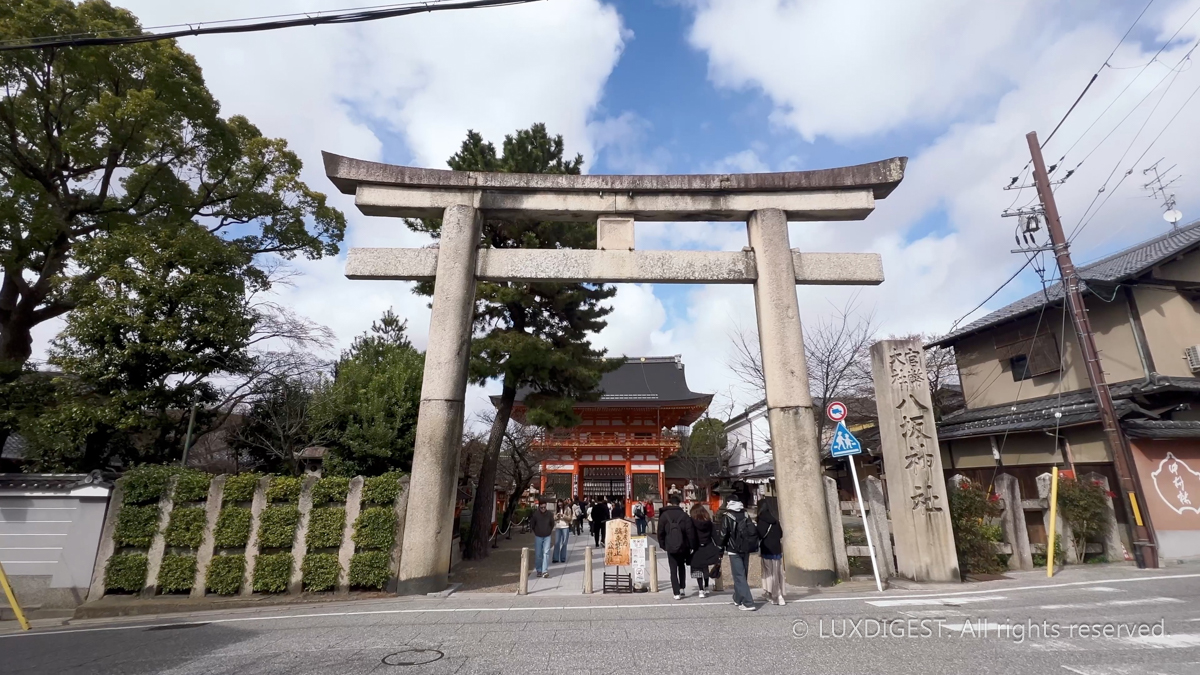
Located at the eastern end of Gion, the historic district of traditional performing arts and the heart of Higashiyama Ward in Kyoto, stands Yasaka Shrine, illuminating the city with its vermilion exterior.
Affectionately known as “Gion-san” by locals, this site transcends a mere religious facility to serve as a cultural cornerstone that preserves the very essence of Kyoto’s thousand-year history.
It is the head shrine for approximately 2,300 Yasaka Shrines and Gion Temples scattered throughout Japan, and serves as the central stage for the “Gion Matsuri,” one of Japan’s three major festivals registered as a UNESCO Intangible Cultural Heritage.
Offering a tranquil historical atmosphere during the day and a dreamlike nightscape created by hundreds of lanterns at night, this comprehensive account details the history, architecture, and festivals of Yasaka Shrine, as well as practical travel information.
1. The Origin and History of Yasaka Shrine: A Center of Faith Enduring for a Thousand Years
The history of Yasaka Shrine dates back to 656 AD (the Asuka period), before Kyoto became the capital of Japan (Heiankyo).
There is an interesting historical background regarding the founding of the shrine; the shrine’s official history records that Iriji, an immigrant who was an envoy from Goguryeo, established the shrine by enshrining the spirit of the principal deity, Susanoo-no-Mikoto, thus demonstrating a deep ties with Korea.
In fact, analysis of timber discovered during renovation work revealed that pine wood from the Gyeongsang region of Korea, which is not found locally in Japan, was used.
In the past, it was known as “Gion-sha” or “Gion Kanshinin,” a fusion of the Buddhist guardian deity “Gozu-tenno” and the Shinto deity “Susanoo-no-mikoto.”
However, following the Meiji government’s decree on the separation of Shinto and Buddhism in 1868, it was renamed to its current name, Yasaka Shrine. Originally, rather than serving as a place of prayer for making wishes, it has been revered as a “center for the eradication of plagues” to purify the city and ward off terrifying epidemics and disasters rampant in the urban area.
2. Architectural Beauty Worth Noting: A Treasure Trove of National Treasures and Important Cultural Properties
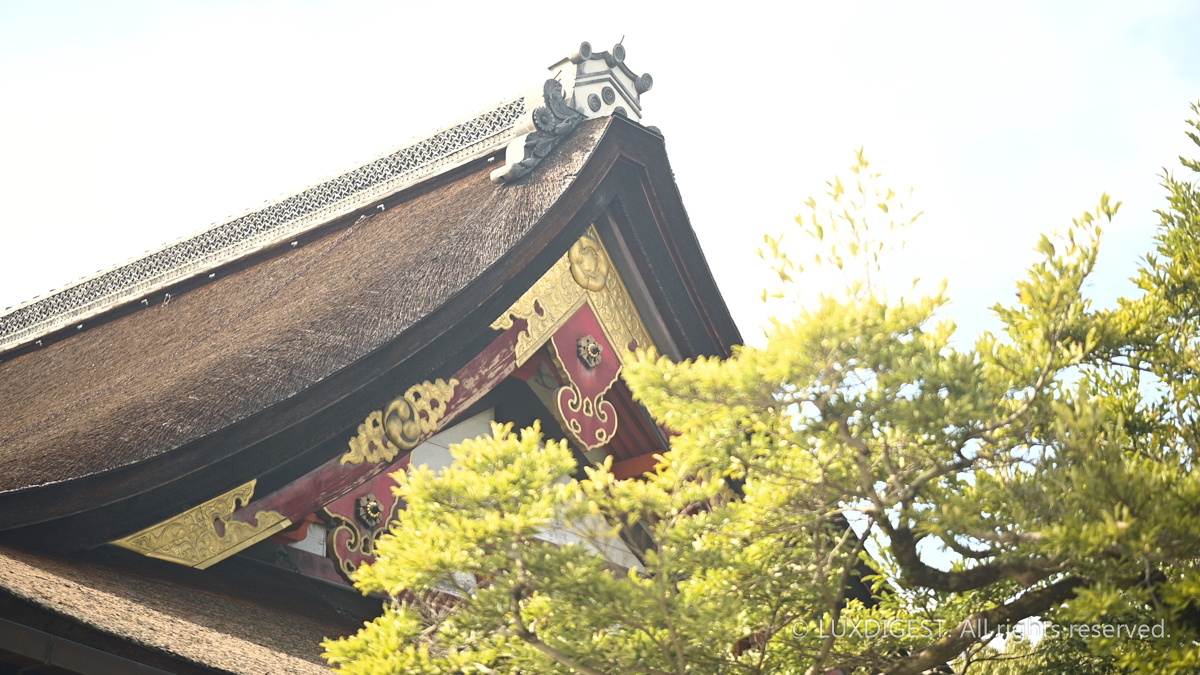
Within the grounds, a total of 29 buildings, including one National Treasure, are designated as Important Cultural Properties, offering a moving experience that feels like visiting a living architectural museum with every step. ┌────────────────────────────────────────────┐
│ [Summary of Yasaka Shrine Layout] │
│ │
│ [West Gate (西楼門)] ─── (Approach Path) ───► [Dance Hall (舞殿)] │
│ (Visual view of Shijo-dori front) (Stage of hundreds of lanterns) │
│ │
│ ▼ │
│ [South Gate (南楼門)] ───────────────► [Main Hall (本殿)] │
│ (The shrine’s true main gate) (National Treasure / Gion-jo style) │
└────────────────────────────────────────────┘
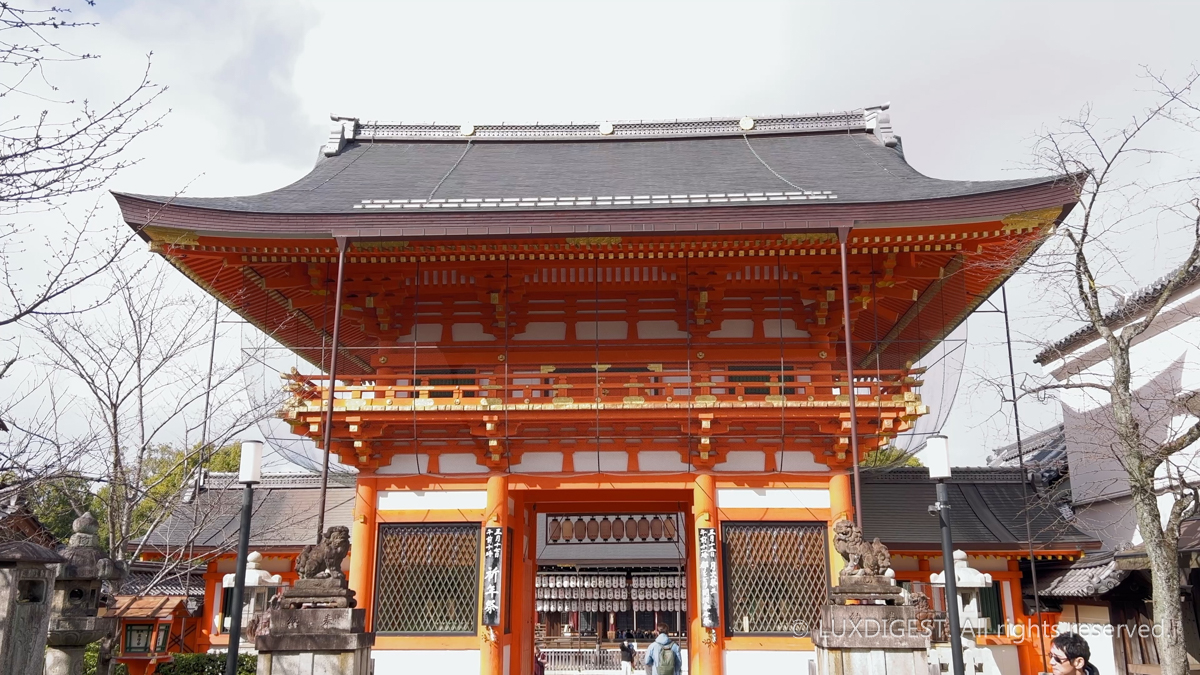
* West Gate (Nishiromon): This is a massive and ornate vermilion gate that stands tall at the end of a dead end as you walk along Shijo-dori, the main street of Kyoto.
Many travelers mistake it for the main gate, but it is a magnificent gate built to block the west, where bad luck is believed to enter according to Feng Shui.
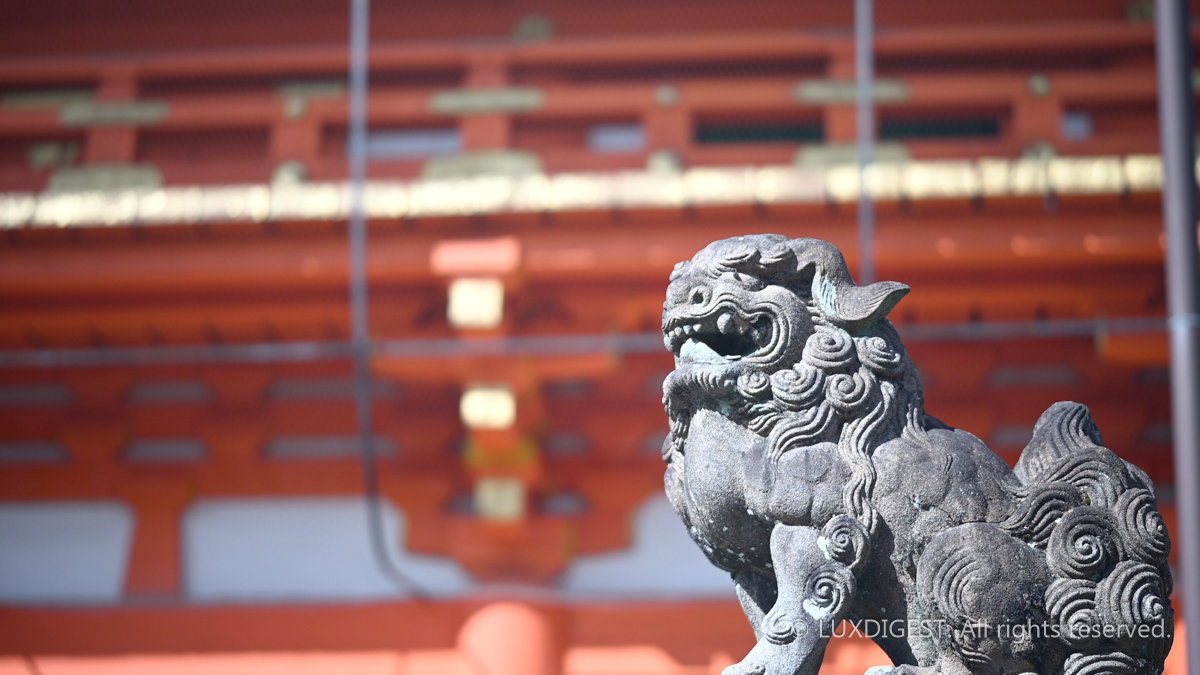
* South Gate (Minamiromon): This is the actual main gate of Yasaka Shrine.
Traditionally, pilgrims who pass through the torii and begin their worship with a pure heart enter through this South Gate.
* Honden (Main Hall) – National Treasure: Designated as a National Treasure in 2020, the Honden was built in a highly unique and rare architectural style known as “Gion-zukuri.”
While it is generally common practice to construct the Shinto shrine (Shrine Seat), where the deity is enshrined, and the worship hall (Haiden), where humans offer prayers, as separate buildings, Yasaka Shrine adopts a structure that integrates these two spaces under a single massive roof.
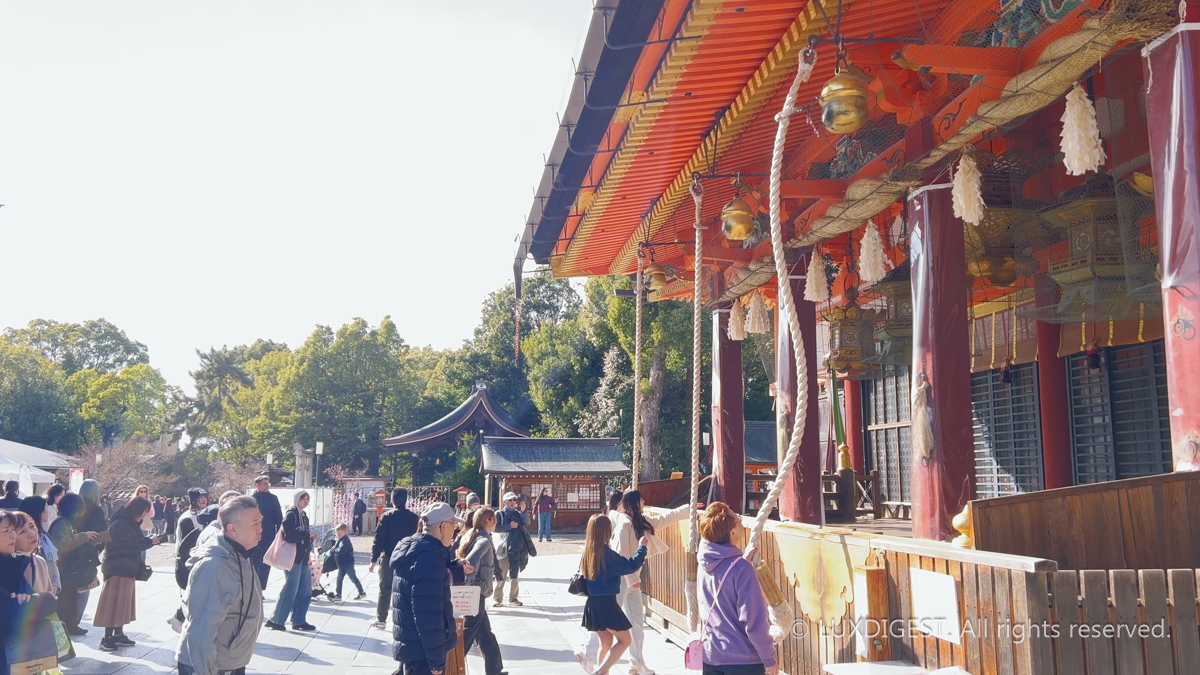
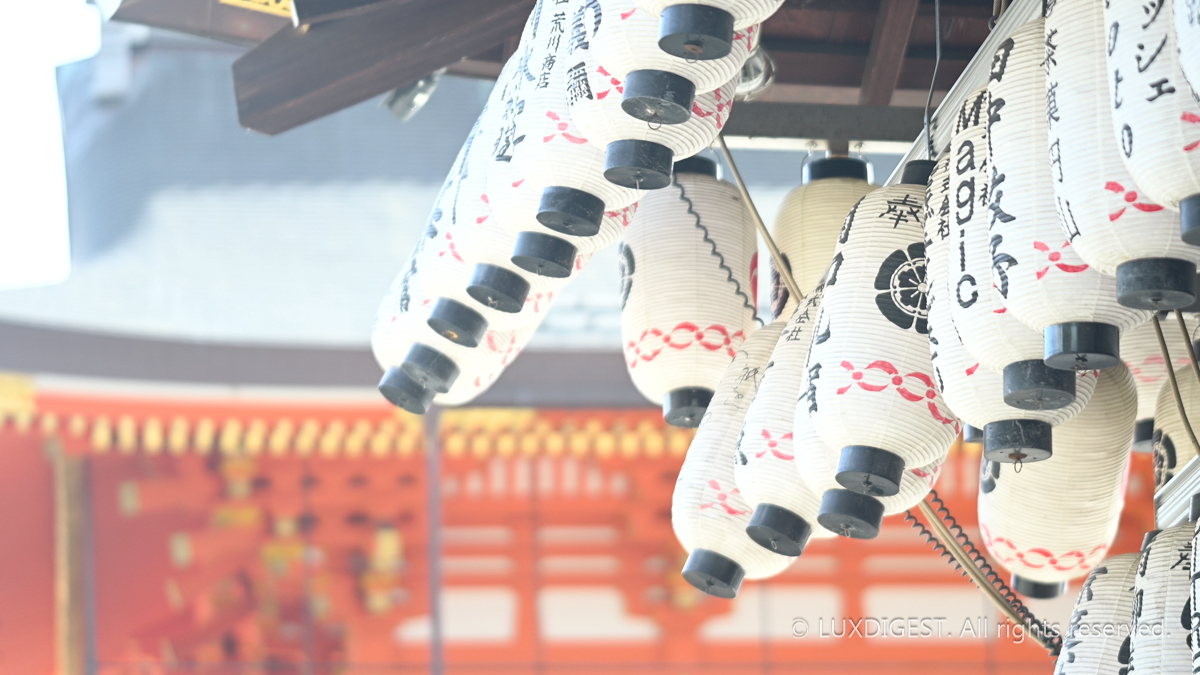
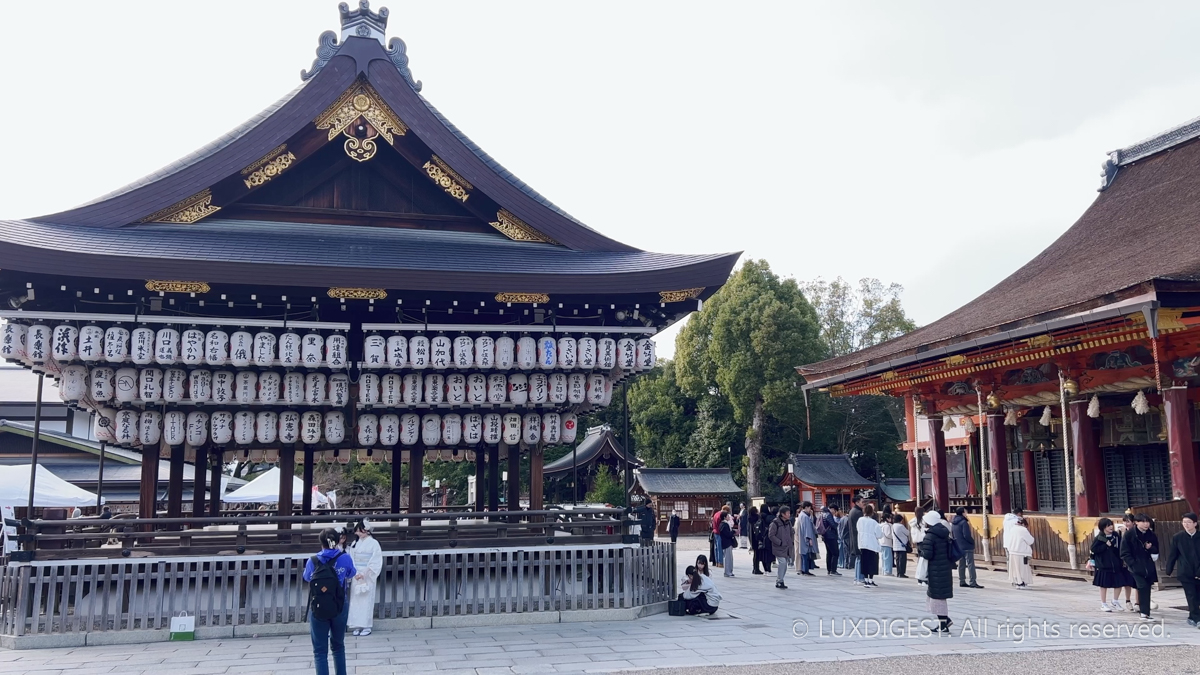
* Maidono (Dance Hall): Located in front of the Honden, this outdoor stage is the highlight of Yasaka Shrine.
Hundreds of lanterns donated by shops in Kyoto’s Gion district, traditional restaurants, and geisha (geiko) families hang densely here.
At night, these lanterns light up in unison, bathing the shrine grounds in a soft and mysterious light.
3. Subordinate Shrines within the Shrine Grounds and Their Special Benefits
In addition to the main shrine, Yasaka Shrine features numerous small subsidiary shrines scattered throughout that grant various wishes, offering the fun of exploring every nook and cranny.
* Migozensha (美御前社): Dedicated to the Three Goddesses of Munakata, the goddesses of beauty, this is a must-visit spot for Gion geishas and maikos, as well as for female travelers seeking to cultivate both external and internal beauty.
Legend has it that applying two or three drops of the mysterious sacred water flowing in front of the shrine, known as “Biyōsu” (Beauty Water), to the skin makes the skin smooth and clears the mind.
* Okuninnushisha (大国主社): Dedicated to the god who brings people together.
A statue of the mythical “White Rabbit of Inaba” stands here, making it a beloved date spot and photo zone for couples.
The shrine is also filled with heart-shaped ema (wish tree plaques) wishing for a good relationship.
* Ekijinsha (Sacred Shrine): This shrine enshrines Sominshorai, the god of epidemic eradication, who is in alignment with the fundamental spirit of Yasaka Shrine.
Every year in late July, the “Chinowaguri” ritual is held here, where participants pass through a giant straw ring to pray for health and longevity.
4. The Festival that Usheres in Kyoto’s Summer: Gion Matsuri
When discussing Yasaka Shrine, one cannot leave out the Gion Matsuri, which is held for a month every year from July 1st to 31st.
The origin of this magnificent festival lies in the “Gion Goryoe,” a ritual in which people carried portable shrines and offered prayers at the shrine to quell the disaster and eradicate the epidemic when a great plague struck Kyoto in 869 AD.
The highlight of the festival is the “Yamaboko Junkyo” (Mountain Bodhi Procession), which takes place on July 17th (Saki Matsuri) and July 24th (Ato Matsuri).
Dozens of massive wooden floats, known as Yama and Hoko, traverse the heart of Kyoto, creating a spectacular sight.
These floats are lavishly decorated with intricate carvings and traditional fabrics, earning them the nickname “moving art museums.”
In particular, the “Tsujimawashi” technique—the simultaneous turning of the giant floats in a traditional manner—is considered the highlight of the festival.
It is said that if you purchase a “Chimaki” (an amulet made of bamboo leaves to ward off misfortune)—a talisman for funerals bestowed by Yasaka Shrine during the festival—and hang it at your front door, it will protect you from disaster for a year.
5. A Practical Travel Guide to Enjoying Yasaka Shrine 200% ## 🚌 How to Get There and Transportation
* Bus: Take city bus No. 206 from the bus stop in front of Kyoto Station and get off at the “Gion” stop; the shrine is directly accessible on foot.
* Train: It takes about 5 minutes on foot from Gion Shijo Station on the Keihan Main Line, or about 10 minutes on foot from Kyoto Kawaramachi Station on the Hankyu Kyoto Line.
Shijo-dori Street, which leads from the station to the shrine, is lined with charming souvenir shops and traditional dessert stores, making for a delightful stroll.
⏰ Operating Hours & Admission Fees
Yasaka Shrine is open on all sides without gates or barriers, allowing free entry at any time, 24 hours a day, 365 days a year.
There is absolutely no separate admission fee (free).
💡 Charms by Recommended Time of Day
1. Early Morning (7:00 AM – Before 8:00 AM): This is the time before package tourists and crowds flock in.
It is ideal for a peaceful stroll amidst clear, refreshing air, allowing you to feel the serene and sacred atmosphere of the shrine.
It is also a great time to take clean, portrait-focused photos. 2. Sunset to Late Night (After 6 PM): As darkness gradually falls, hundreds of lanterns in Muden light up with yellow, unfolding a fantastic and romantic scene completely different from the daytime.
Since it is highly valued as a night view spot, it is recommended to visit just before sunset to experience both charms.
🗺 Recommended Nearby Walking Courses
Yasaka Shrine serves as the perfect hub for a walking tour of Higashiyama, Kyoto.
* Visit Kiyomizu-dera Temple, a UNESCO World Heritage Site, early in the afternoon.
* Walk down the alleys of Sannenzaka and Ninenzaka, hilly streets that preserve the atmosphere of old Kyoto, and enjoy street snacks such as Mitarashi Dango (charcoal-grilled mochi skewers).
* Stop by Yasaka Shrine at the end of the path to admire the night view of soft red lanterns and make a wish.
* Exit the main gate of the shrine and wrap up the day by strolling along Gion Street (Hanamikoji), lined with traditional wooden houses (machiya). If you are lucky, you might encounter a Geisha or Maiko moving to perform a traditional show.
Yasaka Shrine Tour Video
Yasaka Shrine Key Summary
| Category | Main Content |
|—|—|
| Founding Date | 656 AD (Asuka Period, theory that it was founded by Goguryeo envoy Iriji) |
| Main Deities | Susanoo-no-Mikoto, Kushiinada-hime-no-Mikoto |
| Main Benefits | Eradication of epidemics and protection against evil spirits, household safety, forming good relationships, prayers for beauty |
| Representative Cultural Properties | 29 Important Cultural Properties including the Main Hall (National Treasure, Gion-style), West Gate, etc. |
| Representative Festival | Gion Matsuri (Held throughout the month of July every year, one of Japan’s three major festivals) |
| Visiting Conditions | Open 24 hours a day, year-round, free admission |
For centuries, Yasaka Shrine has been a spiritual pillar that comforted the pain of the citizens of Kyoto and protected the city’s well-being. If you are planning a trip to Kyoto, I encourage you to take a leisurely stroll rather than simply passing through it as a photo spot, savoring its thousand-year history, unique architecture, and the heartfelt wishes of the people who have lived there.